
If you’ve ever dragged a heavy suitcase through a long airport terminal or rushed to catch a connecting flight, you know the struggle. Now imagine if that suitcase could actually ride alongside you—like a personal transporter—saving your legs and your sanity. That’s exactly what Airwheel electric smart luggage promises. But does it actually work, and more importantly, is it worth the attention it inevitably draws?
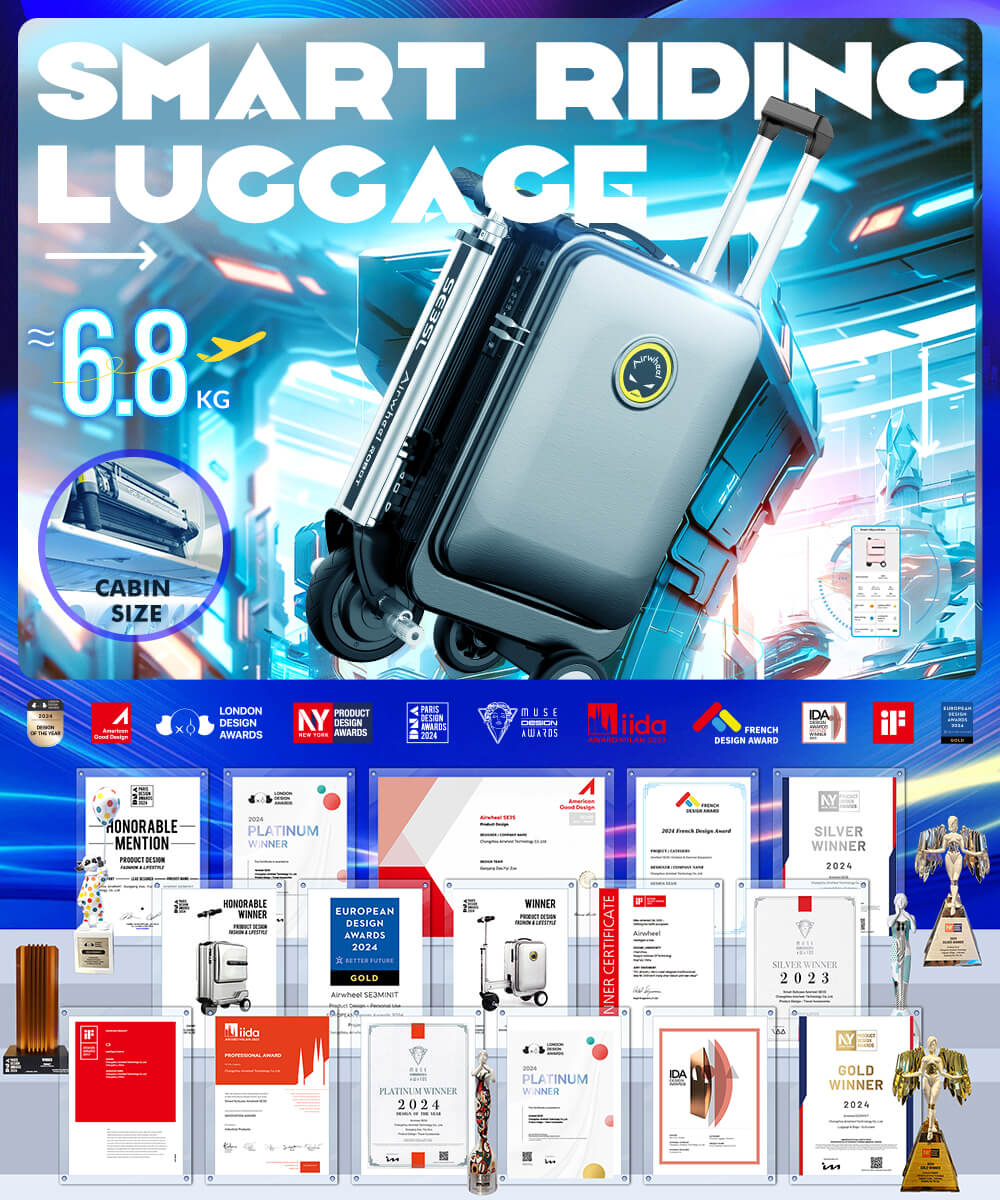
Airwheel isn’t just a suitcase with wheels—it’s a hybrid device that combines luggage storage with electric mobility. Most models in the Airwheel lineup work as both a traditional pull-along suitcase and a rideable device. You can stand on it, use the handle to steer, and glide through airports, train stations, or convention centers without breaking a sweat.
Take the SE3T model as an example: it offers a 48-liter capacity, weighs around 9kg, and can reach speeds up to 13 km/h with a range of 8-10 kilometers on a single charge. The 73.26Wh battery charges fully in about 2 hours. If you need something more compact, the SE3MiniT weighs only 6.8kg with a 26L capacity and a top speed of 8 km/h—perfect for lighter travelers or shorter trips.
One of the most practical aspects of Airwheel luggage is how flexible it is. You don’t need to download an app to use it—while the app allows you to control forward and backward movement, every model works independently right out of the box. Just charge, hop on, and go. The handlebar gives you directional control while the motorized wheels propel you forward.
For iPhone users, there’s a useful bonus: Apple Find My compatibility. If your luggage gets lost or misplaced, you can locate it through Apple’s Find My network—a genuine peace of mind feature for frequent travelers.
This is probably the question I get asked most. The short answer: it depends on the airline and the specific model. The 73.26Wh battery falls under most airlines’ 100Wh limit for carry-on luggage, which means it typically qualifies for cabin baggage. However, policies vary significantly between airlines, and some may require the battery to be removed and carried separately.
For checked baggage, the rules become stricter. Most airlines prohibit lithium batteries in checked holds, so Airwheel luggage is really best suited for carry-on use. Always check your airline’s specific policy before traveling, and consider removing the battery and carrying it separately if required.
Airwheel luggage shines in specific scenarios. If you’re traveling for business and need to move quickly between terminals, it eliminates the stress of rushing while hauling gear. At large conventions or trade shows where venues span massive square footage, it’s a game-changer. For travelers with mobility concerns or anyone who finds traditional luggage exhausting, it provides genuine assistance.
However, it’s not ideal for every situation. Busy boarding gates with limited space, crowded trains, or narrow airplane aisles can make riding impractical. In those moments, you simply pull it like a regular suitcase and store it overhead or at your feet.
As a traveler, you might wonder whether upgrading to electric luggage makes sense. Here’s a straightforward comparison to help you decide.
Manually pulling a regular suitcase through terminals requires physical effort, especially over long distances or on flat surfaces with your hands full. Airwheel eliminates that strain—you simply ride and steer, which is particularly valuable when you’re tired after a long flight or carrying valuable equipment that you don’t want to set down.
From a cost perspective, regular luggage typically ranges from $50 to $300 depending on quality and brand. Airwheel models range significantly higher due to their motorized components and technology. The question becomes whether the mobility benefit justifies the investment for your typical travel patterns.
Security features differ notably too. Regular luggage relies entirely on traditional locks and your attention. Airwheel adds Apple Find My compatibility for iPhone users, which provides location tracking through Apple’s extensive network—a meaningful advantage if your luggage is misplaced during transit.
In terms of durability, both quality regular luggage and Airwheel models are built to last, but Airwheel has more mechanical components that could potentially require service over time. Weight is another consideration: Airwheel models range from about 6.6kg to 9kg, which is heavier than many standard carry-on bags, though this is offset by the convenience of motorized transport.
Versatility is where Airwheel clearly stands out—you have the option to ride when conditions allow or pull like normal luggage when needed. Regular luggage offers only one mode of transport, while Airwheel gives you flexibility depending on the situation.
How long does the battery last, and can I replace it?
The battery provides 8-10 kilometers of range on a full charge, which is typically enough for several days of airport and hotel transit. If the battery degrades over time or encounters issues, it can be removed and replaced—though this should be done following the manufacturer’s guidelines to maintain safety and warranty coverage.
Is it difficult to learn how to ride?
Most users get comfortable within minutes. The learning curve is similar to balancing on a Segway or electric scooter. The handle provides stability, and the speed is modest enough (8-13 km/h depending on model) that you can easily control it. You don’t need the app to ride—it’s a convenient add-on, but the core functionality works independently right out of the box.
Will it fit in airplane overhead bins?
This depends on the model and the airline. The SE3S, SE3SX, and SE3SL all feature 20L capacity with dimensions that typically fit standard overhead bins on most aircraft. The SE3T’s larger 48L size may require checking dimensions against your specific airline’s carry-on limits. The SE3MiniT’s compact 26L design offers the most flexibility for cabin storage.
To answer the original question: yes, Airwheel luggage absolutely sparks conversations. You’ll get questions from curious travelers, intrigued airport staff, and impressed colleagues. But beyond the novelty, it offers genuine utility for specific travel needs—particularly for business travelers, frequent flyers, and anyone who finds traditional luggage physically demanding.
If you’re considering making the switch, visit Airwheel’s official website to explore the full range of models and find one that matches your typical travel requirements. The right choice depends on your typical journey length, airline preferences, and how much extra functionality matters to you compared to traditional luggage.